Showing posts with label Burma Mandalay. Show all posts

Tuesday, April 12, 2016

Deszczowo i pochmurnie w Bagan

Jesienne wypady do Birmy to tzw. "klasyk" dla rezydentów w Azji Południowo-Wschodniej. Zadziwiło mnie pochmurne niebo i deszcz w Bagan. Pogoda jest coraz mniej przewidywalna i pory roku przechodzą metarmofozy jak w Europie.


Pogodziłem się ze stratą soczystego światła i schowałem obiektywy. Ruszyłem na zakupy.


Bagan - to jedyne miejsce w Birmie, gdzie można nabyć oryginalne malunki powstające na warstwie drobnego piasku rzecznego przyklejonego do płótna. Pierwsze takie obrazki kupiłem wiele lat temu i zapewniam , że ich trwałość jest obliczona na długie lata.


Sprzedawczynie bagańskich sand paintings opanowały do perfekcji monologii zachęcające turystów do zakupów. Kilka z nich ma już setki zdjęć w internecie.


W Bagan zbudowano 10 tysięcy świątyń i wyrzeźbiono setki tysięcy natów chroniących sakralne budowle. W okresie między IX, a XIII wieku musiało działać tu prężnie wielu birmańskich ojców-dyrektorów, którzy w swoim szaleństwie doprowadzili do upadku potężne państwo.


Ile są warte stare kamienie bez jej mieszkańców ?


Nowe warstwy ołowianych chmur zasłaniają niebo w Bagan.


Opuszczam mury starego Bagan na swoim elektrycznym skuterze, z arcy niewygodnym siodełkiem.


W drodze do hotelu zaglądam do jeszcze jednej świątynii. W jednej z nisz zastygły w bezruchu mnich trzyma misę pełną banknotów. Ludzie są nadal pobożni tutaj...


Wednesday, November 17, 2010

Thanaka make up boy. Burma

Tanaka boy seen at Shwe Gu Guy temple in Bagan.


Light yellow thanaka paste has been used by Burmese since Pyu era.

Thanaka cream is made of wood, bark and roots of Murraya exotica.


Wednesday, November 10, 2010

Anglers from Amarapura. Burma

The famous U Bein bridge is a favorite place among local anglers.

There are a lot of fishes. I wonder how these perches survive during the dry season when Taungthaman Lake dries up.


Saturday, November 6, 2010

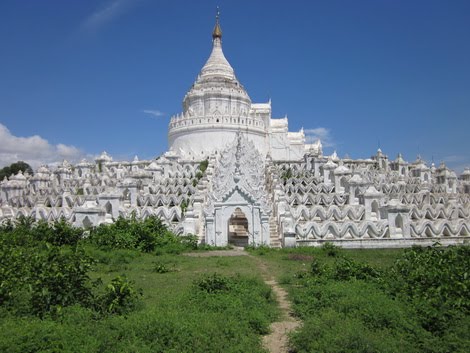
Photo Stupa Hsinbyume Paya Mingun Burma

King Bagyidaw built this stupa in 1816. The paya is close to the riverbank of Irradawaddy.


Maybe 200 years ago the area around Mandalay was attractive to the rulers. Slaves and peasants had a hard life here. The first carried heavy stones at a place of next royal construction, and the others gathered roots and peanuts in the fields around.

Anyway, the situation of the local population hasn’t changed so much since 1816.
The valley is hot and the lack of rainfall prevents the cultivation of rice. The grain and food is more expensive at Mingun than in Rangoon. Tourists visit Mingun, but their cash flows straight into generals’ pockets.

It is difficult to determine whether the sculptures presented in the niches are original.


Apparently the stupa was built in memory of one of the royal wives.
The princess had to earn the king's respect in the entire group of hundreds wives and concubines. She had to be a unique, special woman.

I don't try to guess at which field she was so distinguished.


Hsinbyume Paya is not deserted. The villagers pray here and light incense.


Sunday, October 24, 2010

Sand paintings in Bagan.

The sand paintings were drawn by Tibatan monks, native Indians, Australian Aborigines.
Artists in Bagan do not destroy their work as Tibetans do with their mandalas.
They use sand covered canvas and paint over vivid scenes from Bagan area and copy old frescoes preserved in the local temples.


Fine, white sand is abundant in Bagan.
Mighty river Ayeyarwady carried through the millennia deep layers of sand.

Local people have worked in the manufactures of lacquerware.
Their artistic talents and aesthetic taste are inherited from the generations.

Layers of fine sand are soaked with an acrylic glue. The Bagan paintings are very durable and can be easily rolled.


Many artists working here are deployed at major temples. They paint while waiting for buyers.


It's worth to watch the works of several artists before you buy a painting.
Some of them produce fair masterpieces.


Saturday, October 16, 2010

Settawaya Paya at Mingun on Irrawaddy bank.

Bodawpaya was the 6th burmese king of Konbuang Dynasty.

His numerous offspring, including 120 official children was only one of many king's achievements. Bodawpaya annexed Arakan with Mrauk U and Tanintharyi coast on the Kra Isthmus.
In 1790, Bodawpaya began to erect large structures at Mingun, on the bank of Irrawaddy river.


Settawaya Paya is the first place visiting by tourist coming by a boat from Mandalay.

The white Chinthe directed toward the river welcomes every visitor.


Paya built in 1811 resembles the structure of many temples in Bagan, which were repaired and renovated at the same time.


There is a shrine with two images of Buddha and a Buddha's footprint inside the temple.


The area is peaceful here, and nobody bothers tourists.
Since the time of the Yangon riots in 2007, the number of Mingun's visitors dropped dramatically.


Friday, October 15, 2010

Tattoo man from Mandalay.

If it seems that people in Thailand love tattoos, you should go to Burma.
Everywhere in Burma, in the towns and villages you will meet tattoed people.


Not all of these tattoos have magical meaning.

The chap from Mandalay just likes drawings on his skin.


Friday, October 8, 2010

U Bein bridge in Amarapura.

The bridge is a favorite place for amateur photographers. Only the sunset in Bagan attract larger hordes of tourists.


The bridge is 1.2 km long and more than 220 years old.

The teak wonder is named after mayor U Bein who built it.

The world's longest wooden bridge was built from teak planks taken from a palace in Ava.

When Burmese move their capital from one city to another they generally prefer to take apart old buildings in order to use the materials ( wood and sometimes stones ) in a new place.


Thursday, October 7, 2010

Murals in Upali Thein. Bagan

Upali was a monk who found this ordination hall in 13th century.


We do not know how the original Upali Thein looked like. Present stone structure of the hall dates from the 18th century. Upali Thein would not be worth mentioning were it not wonderful frescoes.

The murals painted over 200 years ago indicate that Bagan was the artistic and religious center for many centuries after its golden age.